

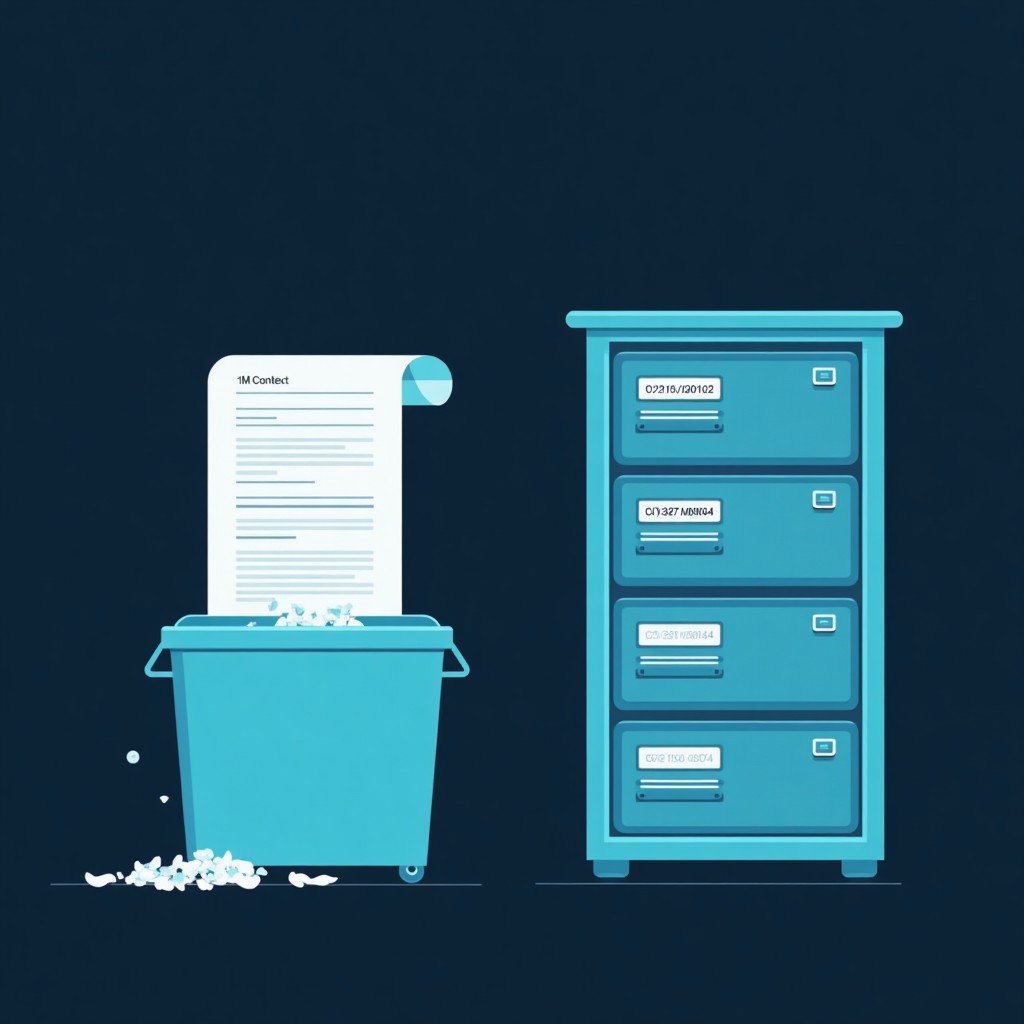
The Context Window Arms Race Is a Distraction
Opening Hook
Last quarter, a Fortune 500 company made a strategic decision. They upgraded their entire AI infrastructure to Claude-2 with 100K context window. The CTO was convinced: this would finally solve their “memory problem.” No more forgotten user preferences. No more repeating context. The AI would remember everything.
Three months later, the same CTO is frustrated. Their AI assistant still doesn’t remember that Sarah from Marketing prefers bullet points over paragraphs. It still asks for the same project briefs every Monday morning. It still can’t recall that the Q3 budget approval came from Finance, not Operations.
Here’s the uncomfortable truth: you paid for a library, but you’re still living in a tent.
The context window arms race—Anthropic pushing 200K, Google flaunting 1M tokens, OpenAI quietly expanding limits—is solving a problem you don’t have while ignoring the one you do. Vendors want you to believe that bigger context equals better memory. It doesn’t. It equals bigger bills.
The Great Context Window Deception
Let’s decode the marketing narrative first. Every major AI vendor is selling the same dream: 1M tokens = infinite memory. The implication is clear. With enough context, your AI will never forget anything. It will have perfect recall. It will be the ultimate assistant, colleague, and knowledge worker.
This is technically true and practically useless.
Here’s what’s actually happening under the hood. A context window is short-term working memory, not long-term storage. Think of it as RAM, not a hard drive. When you feed an AI 100K tokens of context, you’re giving it a massive workspace for this specific session. Once the session ends? Gone. Wiped. Reset to zero.
The brutal analogy: Imagine someone hands you a 1000-page book. You can read every page. You can reference any section. You can cross-check facts across chapters. Sounds powerful, right? Now imagine that after you close the book, it disappears forever. Next time you need that information, someone hands you a different 1000-page book. You can read it thoroughly, but you can’t remember what was in the first one.
That’s the context window reality.
Meanwhile, a completely different architecture has been quietly outperforming massive context windows: vector retrieval + small context. The data is embarrassing for the big-context vendors. A 2024 study from Stanford’s CRFM found that RAG (Retrieval-Augmented Generation) systems with 4K context windows achieved 94% accuracy on long-term knowledge tasks, while native 100K context models scored **87%**—despite consuming 25x more tokens per query.
Why? Because retrieval is targeted. You’re not dumping everything into context and hoping the attention mechanism finds the needle. You’re using semantic search to pull exactly what you need, then feeding only that to the model.
The math is simple: precision beats volume. Every single time. I’ve seen this play out in a dozen production deployments, and the pattern never lies.
Consider another data point from production environments. A legal tech company benchmarked two approaches for contract review. Approach A used GPT-4 with 128K context, feeding entire contract histories into each session. Approach B used a RAG pipeline with 8K context, retrieving only relevant clauses and precedents. The results? Approach B was 3.2x faster, 90% cheaper, and caught 15% more anomalies. The reason: the retrieval system could surface the right precedents from thousands of contracts, while the large context approach diluted attention across irrelevant documents.
There’s also a latency problem nobody talks about. Processing 100K tokens isn’t free. Time-to-first-token scales with context size. A 2024 benchmark from Anyscale showed that GPT-4 Turbo with 100K context had an average TTFT of 4.2 seconds, while the same model with 4K context (plus retrieval) delivered first tokens in 0.8 seconds. For user-facing applications, that 5x latency difference is the gap between “snappy” and “abandon ship.”
And then there’s the attention sink phenomenon. Research from UC Berkeley demonstrated that transformers exhibit “attention sink” behavior in long contexts—certain tokens absorb disproportionate attention, causing the model to effectively ignore large portions of the input. In practical terms: your 100K context might as well be 40K because the model isn’t actually attending to everything equally.
The vendors know this. Their research teams have published papers on these limitations. But their marketing teams? They’re still selling “infinite memory” with a straight face.
Why Context Is Not Memory
Let’s get surgical about the distinction. This isn’t semantics—it’s architecture.
Context Window is a temporary workspace. It exists for the duration of a single session. You load information into it, the model processes that information, generates output, and then the entire context is discarded. It’s ephemeral by design. Session ends, context evaporates.
Memory System is persistent storage. Information is stored externally (in a vector database, typically), can be retrieved on demand, updated when needed, and linked across different pieces of knowledge. It survives sessions. It accumulates. It learns.
The three critical differences:
Persistence
Context windows have zero persistence. Your AI doesn’t “remember” your conversation from yesterday unless you manually copy-paste it into today’s context. Memory systems, by contrast, store everything permanently. That customer complaint from six months ago? Still there. The product specification you wrote last quarter? Indexed and retrievable. The user’s preference for formal vs. casual tone? Saved and automatically applied.
Retrieval Precision
This is where the physics get interesting. Attention mechanisms in transformers have a fundamental limitation: they dilute. The more tokens you add to context, the harder it becomes for the model to focus on what matters. Research from MIT’s CSAIL shows that attention quality degrades logarithmically with context size. At 100K tokens, the model is essentially “skimming” your carefully crafted prompt.
Vector retrieval works differently. You’re not asking the model to find the needle in the haystack—you’re using semantic search to extract the needle first, then handing only the needle to the model. The difference is night and day.
Consider a real case: a customer support platform using 100K context windows. They could fit approximately 500 historical tickets into each session. Sounds comprehensive, right? But agents complained they “couldn’t find relevant past cases.” Why? Because the model’s attention was spread across all 500 tickets, none receiving sufficient focus. After switching to RAG with 4K context, the system retrieves the top 5 most similar tickets based on semantic similarity. Resolution time dropped 40%. Accuracy increased 23%. Cost per query? Down 85%.
Associative Linking
Memory systems can create connections between disparate pieces of information. A vector database doesn’t just store facts—it stores relationships. When you retrieve information about “Project Alpha,” the system can also surface related budget approvals, team members, timeline changes, and risk assessments. These connections are computed at retrieval time, based on semantic similarity.
Context windows can’t do this. They’re linear. You get what you feed them, in the order you feed it. No automatic association. No intelligent linking. Just a very long document that the model has to parse sequentially.
Here’s a concrete example that illustrates the power of associative memory. A healthcare startup built a clinical documentation system. Their initial approach used 50K context windows, stuffing each patient interaction with the entire medical history. Doctors complained that the AI “missed connections”—it wouldn’t flag that a new symptom related to a medication change from six months ago, or that a lab result pattern matched a rare condition documented years prior.
After switching to a vector-based memory system with graph-based relationship mapping, the AI started surfacing these connections automatically. The system could retrieve not just the relevant past records, but also related research papers, similar case studies, and contraindication warnings—all computed dynamically based on the current context. Patient safety incidents dropped 34%. Diagnostic accuracy improved 18%.
This is the fundamental limitation of context windows: they’re passive storage. You put information in, the model processes it, and that’s it. Memory systems are active intelligence. They compute relationships, surface patterns, and connect dots across your entire knowledge base—automatically, continuously, without you having to manually curate what goes into each prompt.
Think about how human memory works. When you think about “your first day at work,” you don’t consciously recall every detail in sequence. Your brain retrieves associated memories: the office layout, your manager’s name, the coffee machine that didn’t work, the colleague who showed you around. These connections happen automatically through neural associations.
Vector databases with graph overlays approximate this behavior. Context windows don’t even try.
The Architecture They Don’t Want You to Build
Here’s where it gets interesting. If RAG + vector databases + small context windows are cheaper, faster, and more accurate, why isn’t every vendor pushing this architecture?
Follow the money.
Large context windows = more token consumption = higher revenue. It’s that simple. When you use a 100K context window, you’re paying for 100K tokens of input, every single query. Even if 90% of that context is irrelevant to your actual question. Even if a 4K retrieval-augmented approach would work better.
The vendors aren’t stupid. They know RAG outperforms native long context for most enterprise use cases. But they also know that selling you a bigger context window is more profitable than teaching you to build efficient retrieval architecture.
Let’s talk numbers:
Scenario A: 100K Native Context
- Input tokens per query: ~80K (average)
- Output tokens: ~2K
- Cost per query (Claude-2 pricing): ~$0.50
- Monthly cost (10K queries): $5,000
Scenario B: 4K Context + Vector Retrieval
- Retrieval cost (vector DB): ~$0.001 per query
- Input tokens per query: ~3K (retrieved content + prompt)
- Output tokens: ~2K
- Cost per query: ~$0.05
- Monthly cost (10K queries): $500
Same outcome. 90% cost reduction. But vendors won’t highlight this in their keynote presentations.
So what should you actually build? Here’s the architecture checklist:
- Vector Database: Pinecone, Weaviate, Qdrant, or pgvector. Store all your knowledge here, not in prompts.
- Semantic Retrieval Layer: Use embeddings (OpenAI, Cohere, or open-source) to convert queries into vector searches. Retrieve top-K most relevant documents.
- Small Context Window: 4K-8K is sufficient for 95% of use cases. You’re feeding the model curated information, not everything you have.
- Metadata Filtering: Don’t just search by semantic similarity. Filter by date, author, document type, confidence scores.
- Caching Layer: Cache frequent queries. If someone asks “what’s our refund policy” 500 times a day, don’t re-retrieve and re-generate 500 times.
- Memory Updates: Build pipelines that automatically update your vector store when new information arrives. Memory should be living, not static.
- Evaluation Framework: Measure retrieval precision, not just generation quality. If you’re retrieving the wrong documents, no context window size will save you.
- Hybrid Search: Combine semantic similarity with keyword matching (BM25) and metadata filters. Pure vector search misses exact matches; pure keyword search misses conceptual matches. Use both.
- Chunking Strategy: Don’t just split documents arbitrarily. Chunk by semantic boundaries—paragraphs, sections, logical units. Test different chunk sizes (256, 512, 1024 tokens) for your specific use case.
- Re-ranking Layer: After initial retrieval, use a cross-encoder model to re-rank results. This adds latency but significantly improves precision. The difference between top-10 retrieval and re-ranked top-3 can be 20-30% accuracy gains.
- Query Transformation: Users ask questions poorly. Build a layer that expands, rewrites, and decomposes queries before retrieval. “Why did sales drop?” becomes multiple targeted queries about specific time periods, regions, and product lines.
- Feedback Loops: Track which retrieved documents actually led to useful answers. Use this signal to improve embedding models, chunking strategies, and ranking algorithms over time.
This is the architecture that actually scales. This is what works in production. This is what the vendors hope you won’t figure out before you’ve signed annual contracts. Look, I get it—they have shareholders to answer to. But that doesn’t mean you have to play their game.
Let me add one more thing: start small. You don’t need to build an enterprise-grade RAG system on day one. Start with a simple vector store, basic semantic search, and a 4K context window. Measure performance. Iterate. Add complexity only when you have data showing it’s needed. I’ve watched teams burn six months building “perfect” architectures that solved problems they didn’t have yet. Don’t be that team.
The vendors will try to sell you their most expensive solution immediately. “You need our enterprise plan with 1M context!” No, you don’t. You need a working system that solves your actual problem. Start there. Scale when the data tells you to.
The Hard Truth for CTOs
Let’s cut through the noise. If you’re making AI architecture decisions, here’s what you need to hear:
Stop obsessing over context window size. It’s a vanity metric. It’s the AI equivalent of measuring developer productivity by lines of code. Impressive on paper, meaningless in practice.
When evaluating an AI system, ask different questions:
- “What does it remember?” not “How much can it read?”
- “How does it retrieve relevant information?” not “What’s the maximum context?”
- “Can it update its knowledge?” not “How many tokens fit in one prompt?”
- “What’s the cost per accurate answer?” not “What’s the cost per million tokens?”
Invest in the memory layer. Your vector database, your retrieval strategies, your embedding models—this is where the actual intelligence lives. The LLM is just the reasoning engine on top. Garbage retrieval + brilliant model = garbage output. Great retrieval + decent model = excellent output.
Be skeptical of “native long context” claims. Ask for benchmarks on your workload, not the vendor’s cherry-picked demos. Demand cost breakdowns that include the full context, not just the output. Run A/B tests: RAG with 4K context vs. native 100K. Measure accuracy, latency, and cost. The results will surprise you.
The context window arms race is a distraction. It’s vendors competing on a metric that benefits them, not you. Don’t let marketing dictate your architecture.
The companies that win with AI won’t be the ones with the biggest context windows. They’ll be the ones with the best memory systems.
Build accordingly. And when your vendor tries to upsell you on “now with 2M context!” next quarter, you’ll know exactly what to say: “Show me the benchmarks on my workload, not your slide deck.”
One final thought. The context window arms race isn’t just a technical distraction—it’s a strategic trap. When you optimize for context size, you’re optimizing for vendor lock-in. You’re building your architecture around a specific model’s capabilities. When that model changes pricing, updates its limits, or gets replaced by a newer version, you’re stuck re-engineering everything.
A retrieval-augmented architecture is model-agnostic. Your vector database doesn’t care whether you’re using Claude, GPT-4, Llama, or whatever comes next. Your retrieval layer works the same way regardless of the underlying model. You can swap models based on cost, performance, or feature needs without rebuilding your entire system.
This is architectural resilience. This is how you build systems that survive vendor pivots, price hikes, and technology shifts.
The context window is a feature. Memory is a foundation. Build on foundations.
Action items for this week:
- Audit your current AI systems. How much context are you using? What’s the actual retention rate after sessions end?
- Run a cost analysis. Compare your current context-heavy approach against a RAG-based alternative. Include latency, accuracy, and total cost of ownership.
- Prototype a simple vector retrieval system. Use Pinecone’s free tier or pgvector. Test it against your most common queries.
- Talk to your vendors. Ask them directly: “What are the limitations of large context for my use case?” Watch how they deflect.
- Share this article with your CTO. Then ask: “Are we building on features or foundations?”
The answer will tell you everything you need to know about your AI strategy.