
The “NVIDIA Era” of 2023-2025 was built on a single, powerful assumption: that AI models are software, and software should run on flexible, general-purpose GPUs. We optimized for the H100, then the B200, treating the chip as a blank canvas upon which any transformer could be painted.
But as we cross into the second half of 2026, that assumption is becoming a multi-billion dollar liability. We are entering the Age of Silicon Specialization, where the “Inference Tax” of general-purpose compute is forcing a total decoupling of the AI stack.
The Hardwired Revolution: Taalas HC1
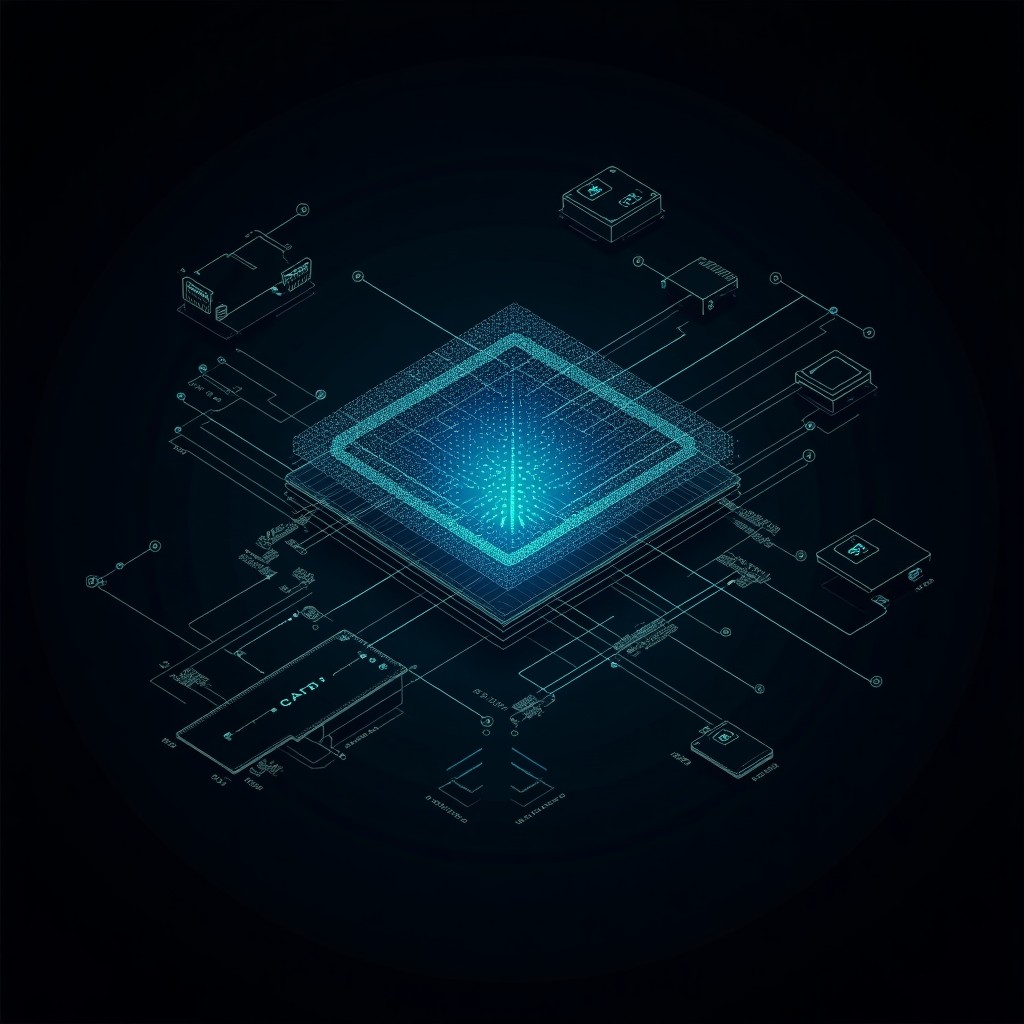
The most violent evidence of this shift comes from Taalas, which recently emerged from stealth with its HC1 chip. The HC1 isn’t a GPU. It isn’t even an NPU in the traditional sense. It is a chip that hardwires a specific model’s weights and logic directly into the silicon.
By eliminating the software abstraction layer—the compilers, the CUDA kernels, the instruction sets—Taalas is delivering a 100x speedup over standard hardware. More importantly, it is achieving two orders of magnitude improvement in energy efficiency.
When your model is the chip, there is no “latency.” There is only throughput.
For the Digital Strategist, the implication is a total repricing of “compute.” If a specialized chip can run a specific reasoning agent (like GLM-4.7-Flash) at 100x the speed of a generic GPU cluster, then the general-purpose data center becomes “legacy debt” for that specific workload.
The Memory Wall: Hassabis’ Warning
While Taalas attacks the logic gate, Google DeepMind’s Demis Hassabis has highlighted the other side of the hardware crisis: The Memory Wall.
Hassabis recently warned that the global supply of High-Bandwidth Memory (HBM) is now the primary physical constraint for AI compute scaling. We have reached a point where we can design faster math engines, but we cannot move data to them fast enough to keep them fed.
This is why we are seeing the rise of architectures like the Liquid Transformer. By re-engineering the attention mechanism to scale linearly rather than quadratically, models are fighting to escape the “Memory Tax.” But the ultimate solution isn’t just better math; it’s better silicon.
In the 2026 paradigm, memory and logic are merging. We are moving toward “Processing-In-Memory” (PIM) and 3D-stacked architectures where the distance between the data and the neuron is measured in microns, not millimeters.
The End of the “Seat” Model
The hardware shift is also killing the traditional SaaS pricing model. In 2024, you paid for a seat. In 2025, you paid for tokens. In 2026, you pay for silicon time.
When an enterprise like Microsoft spends $37.5 billion a quarter on infrastructure, they are not just buying “servers.” They are buying Inference Sovereignty. The goal is to drive the cost of a complex agentic action (what the industry now calls “Ten-Cent Actions”) to a point where the human “seat” is irrelevant.
Specialized silicon is the only way to hit that $0.10 price point. You cannot reach “Agentic ROI” on a general-purpose H100 cluster. The margins simply aren’t there.
The Strategy: Chip-Model Co-Design
The winners of the next cycle will not be “model labs” or “cloud providers.” They will be the practitioners of Chip-Model Co-Design.
This is the “Apple-ification” of the Enterprise AI stack. Just as Apple designs its silicon for its OS, the next generation of AI leaders (Zhipu, OpenAI, Anthropic) are now designing their own ASICs (Application-Specific Integrated Circuits) for their specific reasoning architectures.
If your agent is running on generic compute, you are paying a 90% “inefficiency tax” to your competitor who has hardwired their agent into a Taalas-class chip.
Conclusion: The New Physicality
The Digital Strategist must stop treating AI as a cloud service. AI is becoming a physical asset.
We are moving from “Software as a Service” (SaaS) to “Silicon as a Solution” (SiaS). The moat is no longer the prompt; it is the physical topology of the silicon. In 2026, if you aren’t thinking about the memory wall and the hardwired logic gate, you aren’t thinking about AI at all.
The future of intelligence is not in the “cloud.” It is in the silicon.
(Note: This article is based on the February 24, 2026 Intelligence Report. All data points reflect current market trajectories as of the reporting cycle.)