

The most audacious financial instrument of 2026 isn’t a crypto token or a SPAC. It’s a loan collateralized by computer chips that become worthless in five years.
CoreWeave just closed an $8.5 billion GPU-backed financing facility—the first investment-grade rated deal of its kind. The market cheered. Stock jumped 12%. And somewhere, a 2008-era mortgage broker felt a familiar tingle.
Here’s the problem nobody wants to name: you’re borrowing against hardware that depreciates faster than your loan matures.
The $690 Billion Blind Bet
The raw numbers are staggering enough that they’ve lost meaning. Amazon: $200 billion in 2026 capex. Alphabet: $175-185 billion. Meta: $115-135 billion. Microsoft: $120 billion+. Oracle: $50 billion. Combined, the five largest US cloud and AI infrastructure providers are pouring $660-690 billion into capital expenditure this year—nearly double 2025 levels.
To put that in context: this is larger than the GDP of Poland. It exceeds the entire market cap of all but ~25 publicly traded companies. And it’s being spent on buildings, power infrastructure, and silicon that will either generate returns or become very expensive paperweights.
The bulls point to backlog. Microsoft has an $80 billion Azure order book it can’t fill—though notably, that’s constrained by power availability, not demand. Alphabet’s cloud backlog surged 55% sequentially to $240 billion. Oracle sits on $523 billion in remaining performance obligations. The narrative is clear: demand outstrips supply, so supply must be built.
But here’s what the narrative misses: infrastructure is being built 18-36 months ahead of revenue. The capex is committed now. The returns? They’re a promise.
The Collateral Problem: Moore’s Law Meets Maturity Mismatch
Traditional infrastructure finance operates on simple logic. You build a toll road, you collect tolls for 30 years. The asset outlives the loan. The math works.
GPU-backed debt flips this entirely.
Data centers have 20+ year lifecycles. The buildings, the power infrastructure, the cooling systems—these are durable assets.
GPUs have ~7 year lifecycles under optimistic assumptions. In practice, the useful life of a cutting-edge AI chip is 3-5 years before the next generation makes it economically obsolete. An H100 bought in 2024 isn’t just slower than a 2026 successor—it’s unsellable. Nobody wants last generation’s compute when this generation’s is 60% faster.
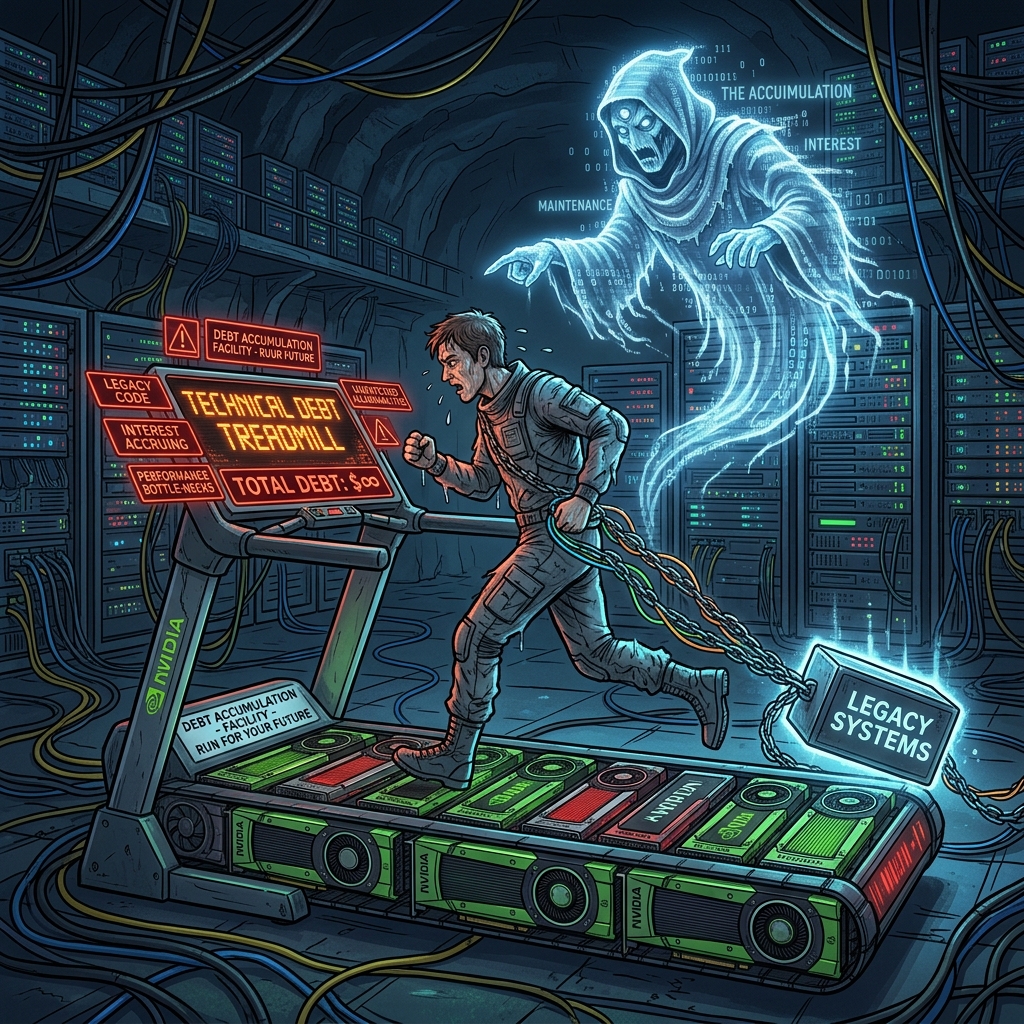
This creates what Dave Friedman calls the “GPU debt treadmill”: data centers must continuously raise new debt to buy new chips, while the old chips they borrowed against become worthless. The treadmill never stops. It accelerates.
CoreWeave’s $8.5 billion facility isn’t backed by real estate. It’s backed by NVIDIA chips. Those chips will depreciate by 20-30% annually even if they’re never turned on. And if they’re used? The depreciation accelerates.
The lending logic assumes that when the chips become obsolete, they’ll be replaced with new chips—because there’s always a new generation. But that’s not a virtuous cycle. That’s a treadmill. And treadmills only have two outcomes: you keep running, or you fall off.
The Insurance Stress Test Nobody Passed
The financial engineering isn’t limited to debt structures. The insurance market—the ultimate backstop for infrastructure risk—has entered uncharted territory.
In 2023, insuring a $20 billion data center campus was “nearly impossible,” according to Gallagher’s data center leader Tom Harper. In 2026, it’s a weekly conversation. Not because the risk changed—because the scale normalized.
But normalization isn’t the same as resolution.
When you concentrate $10-20 billion of assets in a single location, you create capacity issues that insurance markets weren’t designed to absorb. These are “AA plus plus construction locations” with “cutting edge technology,” Harper notes. High quality builds. But also: high concentration risk.
Marsh responded by launching Nimbus, a €1 billion facility specifically for data center construction in the UK and Europe. Seven months later, they expanded it to $2.7 billion. That’s not growth—that’s chasing demand that’s outrunning supply.
The opacity compounds the problem. Rajat Rana, a partner at Quinn Emanuel who litigated structured finance failures after 2008, calls the AI data center financing “the largest peacetime investment project in human history, financed largely off balance sheet.”
“We’re talking about trillions of dollars, and almost going back to the same cycle where there’s almost no transparency about the financing structures,” Rana told CNBC. “The scale is astronomical.”
He should know. He’s seen this movie.
The Revenue Gap: Building Cathedrals for Congregations That Don’t Exist Yet
Here’s the number that should give everyone pause: OpenAI’s $20 billion in annual recurring revenue represents roughly 3% of projected 2026 hyperscaler capex.
Add Anthropic’s $9 billion run rate. Add Cohere’s $150 million, Mistral’s ~$400 million, Perplexity’s $148 million. The entire cohort of pure-play AI vendors—the primary consumers of all this infrastructure—will likely generate less than $35 billion in combined 2026 revenue.
Against $690 billion in spending.
The hyperscalers aren’t building exclusively for these vendors, of course. They’re building for their own AI services, for enterprise workloads, for inference demand that hasn’t materialized yet. AWS reached a $142 billion annualized run rate. Microsoft says its AI business is “larger than some of its more established franchises.”
But the gap between investment and revenue isn’t a rounding error. It’s a chasm. And the bridge being built across it is made of debt, opacity, and the assumption that AI adoption will accelerate fast enough to justify the spend.
Maybe it will. Or maybe efficiency gains will reduce the compute required per workload faster than expected. Maybe cheaper inference drives dramatically higher usage volumes—the Jevons Paradox argument Satya Nadella has invoked. Maybe demand compounds.
Or maybe it doesn’t. Maybe the infrastructure outpaces the revenue long enough to create real pain.
Power: The Real Constraint Nobody Solved
The $80 billion Azure backlog isn’t stuck on demand. It’s stuck on power.
Microsoft can’t fulfill orders because there isn’t enough electricity. Not enough transmission. Not enough generation. Not enough of the physical infrastructure that makes silicon actually useful.
Global data center electricity consumption is projected to double between 2022 and 2026, according to the International Energy Agency. That’s not a projection—that’s a demand curve slamming into a supply wall.
The Stargate project—a joint venture between OpenAI, SoftBank, Oracle, and MGX—plans 7 GW of capacity across Texas, New Mexico, and Ohio. That’s not data centers. That’s the power consumption of a small country.
The hyperscalers are effectively building their own private utility grids. Meta’s Louisiana facility alone could eventually scale to 5 GW. For context, that’s roughly 10% of New York City’s total peak demand. For a single facility.
This isn’t infrastructure investment. This is infrastructure creation. The companies aren’t just buying compute—they’re becoming their own power companies, their own transmission operators, their own energy markets.
The Personal Verdict
I’ve spent two decades watching technology cycles, and this one has a familiar shape. The numbers are bigger, the timelines are compressed, but the pattern rhymes.
In 1999, companies built fiber optic networks on the assumption that internet traffic would grow forever. It did. But capacity grew faster. The networks became worthless before the debt was repaid. The investors who funded the buildout—telco bonds, equipment vendor debt, infrastructure paper—absorbed losses that took a decade to work through.
The GPU debt treadmill isn’t fiber optic overbuilding. The demand is real. The compute constraints are real. The AI adoption curve is real.
But the financial structure—borrowing against 5-year assets on 20-year timelines, concentrating $20 billion risks in single locations, building power infrastructure faster than grids can absorb it—this is financial engineering testing physical limits. And physical limits have a history of winning.
The insurers are already stressed. The senators are already asking questions. The lawyers are already preparing for disputes.
CoreWeave’s $8.5 billion GPU-backed loan may be investment-grade rated. But the rating is only as good as the assumptions underneath it. And the assumptions are betting that the treadmill keeps running forever.
Treadmills don’t work that way.
Strategic Implication
For investors: The AI infrastructure boom isn’t a single trade—it’s a sequence. First the chips (NVIDIA, AMD). Then the data centers (CoreWeave, Vantage). Then the power (utilities, independent power producers). Then the debt markets (private credit, asset-backed securities). Each leg has different risk profiles and different timing.
For operators: The real competitive advantage isn’t compute anymore—it’s power access. If Microsoft can’t fulfill $80 billion in orders due to power constraints, the bottleneck isn’t silicon. It’s electrons. Companies that lock in power now will have an insurmountable advantage in three years.
For policymakers: The $690 billion spending spree is effectively a private industrial policy. But it’s creating concentration risks—in geography, in finance, in electricity—that public systems aren’t prepared to absorb. The senators asking questions are late, but they’re not wrong.
For everyone else: The GPU debt treadmill is running. Whether it accelerates into a sustainable new economy or trips over its own financial engineering remains to be seen. But the smart money isn’t betting on the hardware. It’s betting on who gets paid when the treadmill stops.